Heads-up Computing Homepage
Overview
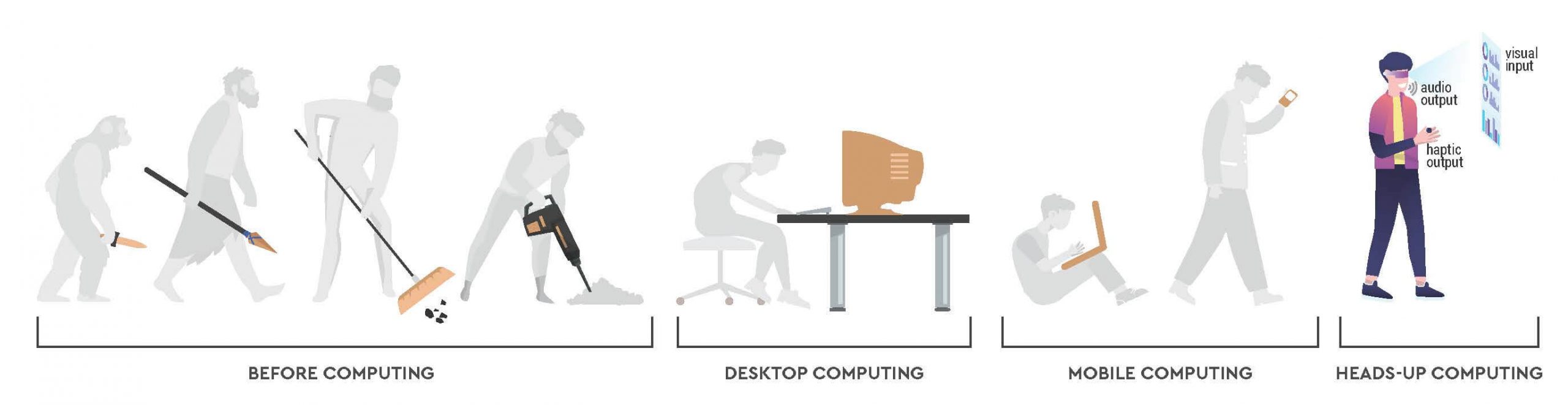
Heads-Up Computing is an emerging field in Human-Computer Interaction (HCI) that focuses on creating computing systems that integrate smoothly into a user's natural environment and daily activities. The objective is to provide information and computing capabilities to users in a way that is unobtrusive and complementary to their current tasks, rather than distracting or requiring dedicated attention away from their immediate real-world context.
To clarify further, here's a breakdown of the components that contribute to Heads-Up Computing:
Body-Compatible Hardware Components
Current devices are not designed to support seamless use during daily activities. Mobile phones allow us to interact with digital information on the go, but they often distract us, turning us into so-called smartphone zombies. This is because their input and output components are centralized on the device, requiring us to adjust our input and output to match the device's design.
Heads-up computing, on the other hand, is designed to align with human input/output capabilities. Rather than using a centralized design, it employs a distributed design and separates the computer into two pieces: the head-piece and the hand-piece.
Responsibilities of the head-piece:
- Provide real time visual and aural feedback
- Understand what human sees and hears
- Understand facial gestures & emotion
- Understand attention
- Speech input
Responsibilities of the hand-piece:
- Provide real time haptic feedback
- Track hand position, posture, movements
- Provide additional interaction commands
This is merely a functional division, and its implementation can vary. For instance, Apple's vision pro integrates the hand-piece within the head-piece, eliminating the need for a separate hand-based device.
Multimodal Voice, Gaze, and Gesture Interaction
For seamless interaction during daily activities, it's essential to utilize complementary channels. This is because most daily tasks engage human's visual attention and manual movements. If digital interaction also heavily depends on these, it could cause significant conflict and disrupt seamless interaction.
Voice
Allows hands-free control and communication with devices.
- EDItalk | Proceedings of the 2018 CHI Conference on Human Factors in Computing Systems
- EYEditor | Proceedings of the 2020 CHI Conference on Human Factors in Computing Systems
- GlassMessaging: Towards Ubiquitous Messaging Using OHMDs; Proceedings of the ACM on Interactive, Mobile, Wearable and Ubiquitous Technologies: Vol 7, No 3
Gaze Tracking
Uses eye movement to guide or control aspects of the computing experience. Research in this area will become easier with the arrival of Apple's Vision Pro.
Micro or Complementary Gesture Recognition
Leverages gestures that can be performed reliably and complementarily while engaging in other tasks. This includes micro-hand or finger gestures, head gestures, etc.
Environmental aware & fragmented attention friendly interaction design
→ Resource Aware Interaction Model
Heads-Up Computing interfaces are specifically designed to be environmentally aware and suitable for fragmented attention. This means they can be effectively interacted with during mobile multitasking scenarios. Designing these interfaces requires a complete redesign.
- Redesign the text spacing: Not All Spacings are Created Equal
- Use icon instead of text for notifications: Can Icons Outperform Text?
- Redesign the information presentation: LSVP: Towards Effective On-the-go Video Learning
Resource Aware Interaction
Designing interfaces that are friendly to fragmented attention is one approach to creating versatile interfaces for heads-up computing. Another approach involves designing interfaces that are aware of and responsive to the user's current state, including their cognitive load and physical abilities. The system adapts its interactions based on the user's capacity, ensuring that information is delivered and tasks are managed in a way that aligns with the user's available resources, which we call resource aware interaction.
For example, if a user is deeply focused on a complex task, the computing system would minimize interruptions and provide information subtly. On the other hand, if the user is in a more relaxed state, the system might present information that requires more attention.
Conference Programs →
Based on these models, we can design optimal interfaces to cater to various situations a user may encounter.
Summary
Heads-Up Computing aims to reshape the way we interact with technology by creating a computing experience that feels like a natural extension of the user's abilities and their surrounding environment. This approach signifies a significant shift from a device-centric to a human-centric model of computing, where the technology serves the user in a subtle and unobtrusive manner, enhancing their interaction with the real world rather than obstructing it.
As a lab, we have made some progress in this exciting field, pushing the frontiers of what is possible with this technology. However, we've only just begun to uncover the vast potential that this field holds. There's still a significant amount of exploration and experimentation required to fully understand and leverage the capabilities of heads-up computing.